
What Is AI?
Learning from examples, explained for every age, with the story of how we got here and where it might go next.
Sponsored by Argo, a private AI journal
What Is AI? Learning from Examples
Class 0 asked what a computer is: a machine that takes something IN, thinks, and puts something OUT. This class asks the next question, what happens when the thinking part learns for itself? A normal computer follows rules we wrote. An AI learns from examples we showed it, and then it can handle things nobody ever wrote a rule for.
“Nobody ever gave you a rulebook for what a cat is. You just saw a lot of cats. That is exactly how AI learns.”
Say this first, to the whole room. Every age level below is a deeper version of it.
The STEM lesson
What is AI, explained by age
The same idea, told at the right depth for each child. Explain the youngest version to everyone, then add a layer for the older kids while the little ones start drawing.
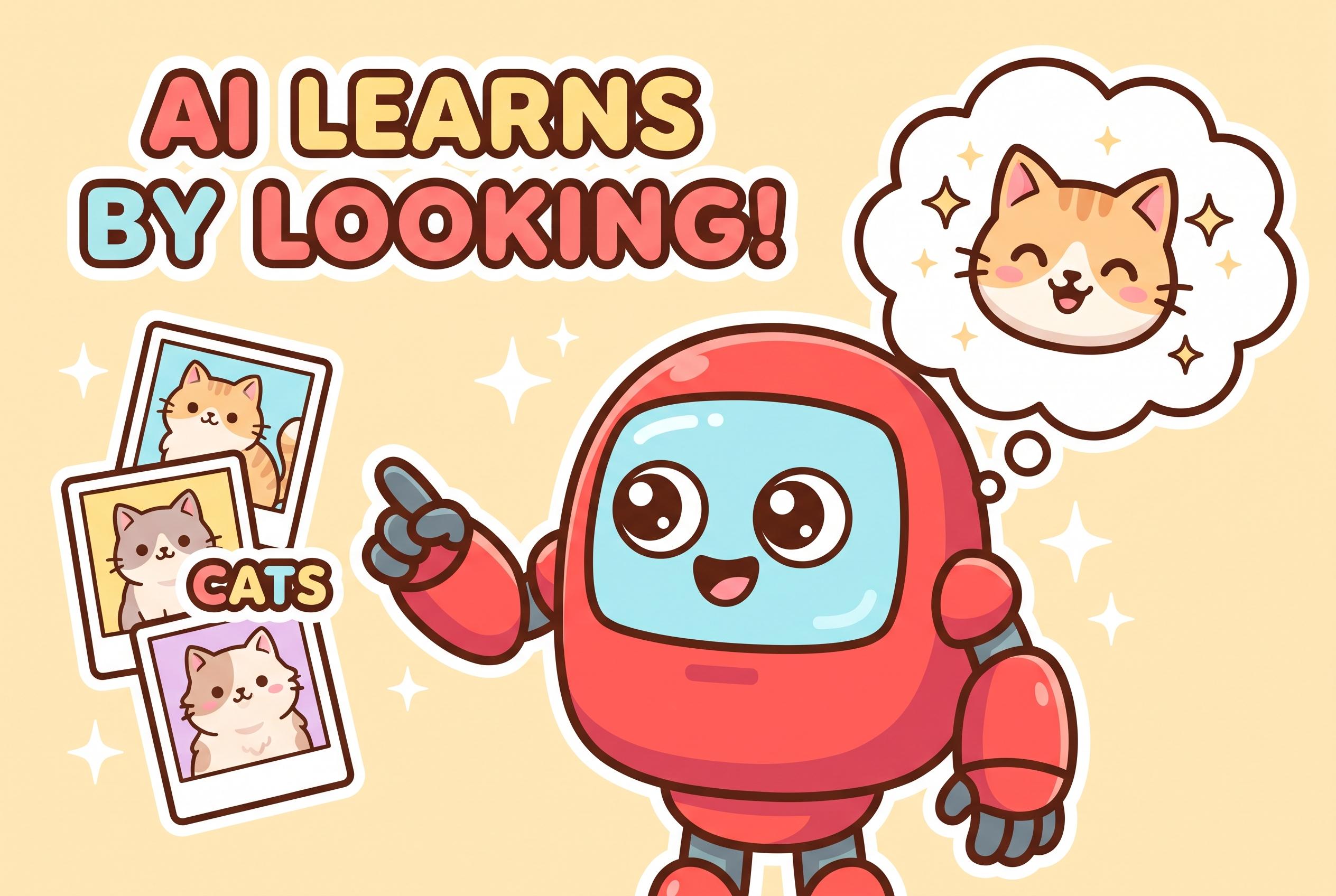
AI learns by looking
We show the robot lots and lots of cat pictures. Cat. Cat. Cat. And now the robot knows: it can find a cat all by itself. Show it many, and then it knows.
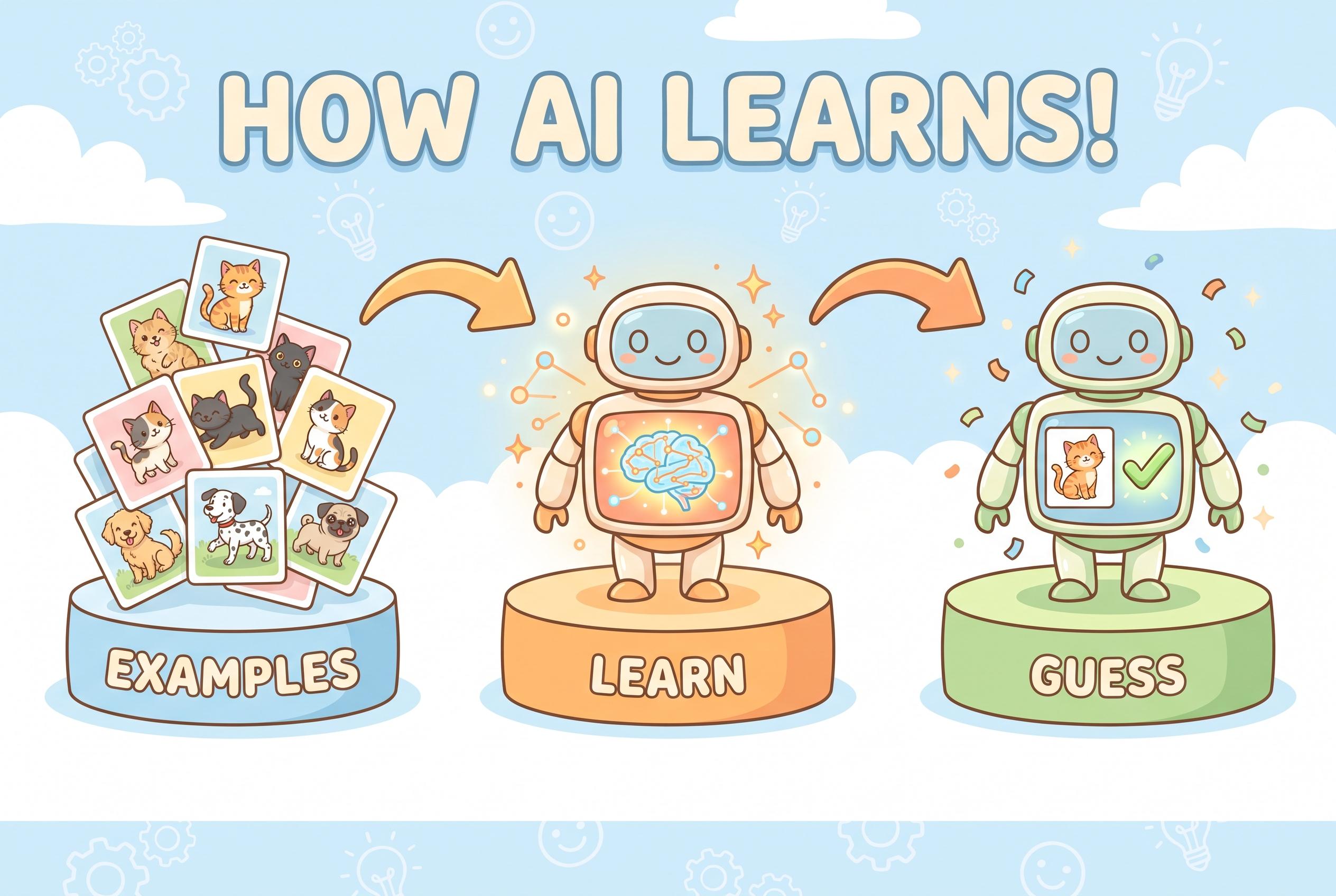
Examples → Learn → Guess
A normal computer only does what we tell it, step by step. AI is different. We do not give it the rules. We show it thousands of examples, it finds the pattern hiding inside them, and then it can guess about things it has never seen before. And that is the key word: an AI guesses. A very good guess, but a guess. That is why it is sometimes wrong.
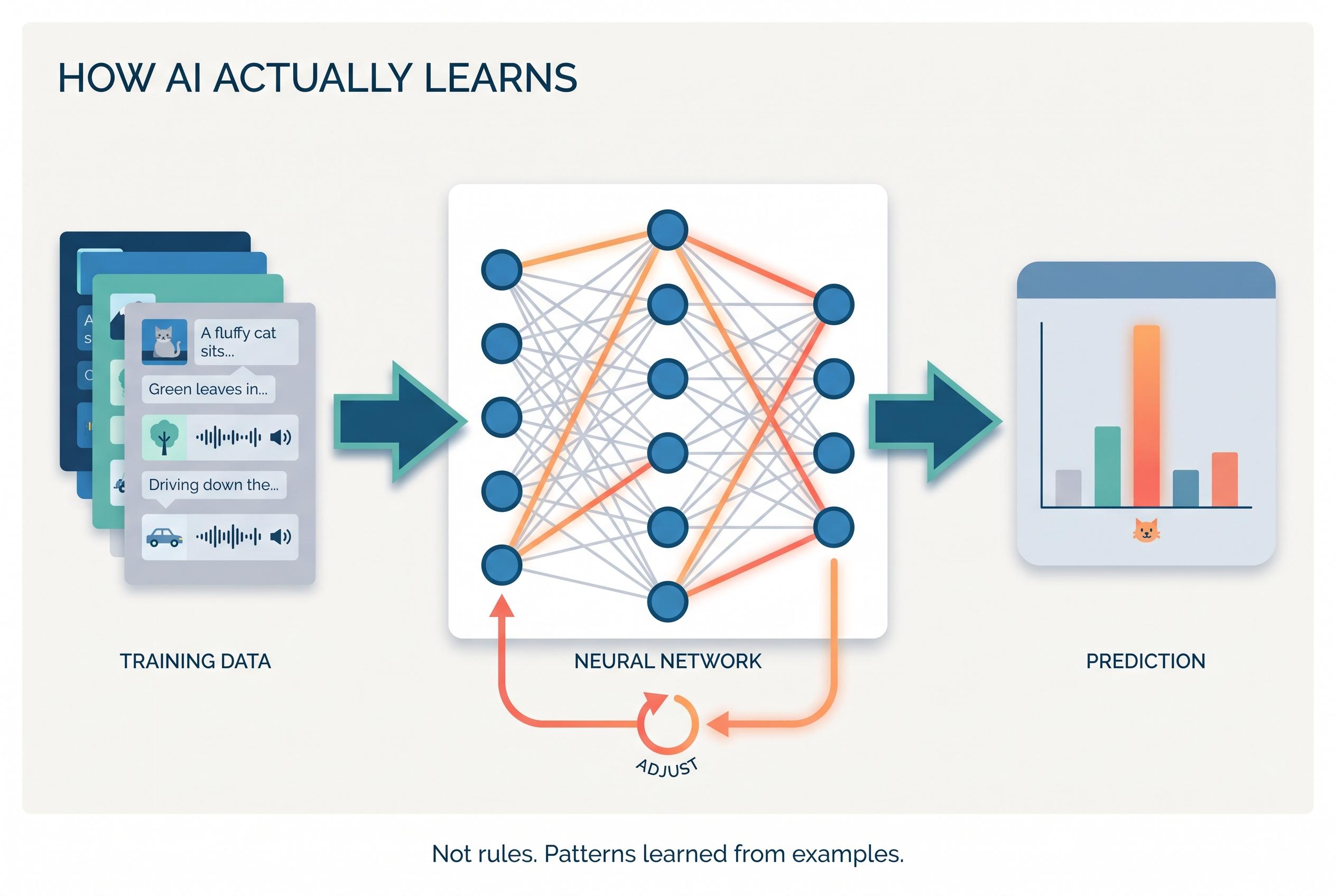
Training data, neural networks & prediction
Under the hood, an AI is a huge web of simple connected dots called a neural network. At the start it is completely random and useless. You feed it training data, it makes a prediction, you tell it how wrong it was, and it nudges its connections to be slightly less wrong, billions of times. Nobody programmed the rules; the rules got learned. And a chatbot is, at heart, predicting what comes next. It does not check whether what it says is true, which is why it can be confidently, fluently wrong.
The four pieces
What the oldest kids should be able to name by the end.
The one-glance ladder
The story of AI
Tell this as a story with characters, not a list of dates. The kids remember the people. Three or four beats is plenty for the little ones; the older kids can take the whole arc.
Ada Lovelace has the first idea
Working on a machine that was never even built, she writes the first computer program, then asks the question everyone would argue about for the next two hundred years: could a machine ever create something new, or only do what it was told?
Alan Turing asks “can machines think?”
He decides the question is too slippery, so he replaces it with a game: if you are chatting with something and cannot tell whether it is a person or a machine, does the difference matter? We still call it the Turing Test.
The field gets its name
A summer workshop at Dartmouth College brings together John McCarthy, Marvin Minsky, Claude Shannon and others. McCarthy coins the phrase “artificial intelligence.” They think a good summer’s work might crack it. It did not.
The first machine that learns
Frank Rosenblatt builds the Perceptron, a real machine, with motors and wires, that learned to tell simple shapes apart from examples. The great-great-grandparent of everything today.
The first chatbot
Joseph Weizenbaum writes ELIZA, which imitated a therapist using simple tricks. He was disturbed by how many people poured their hearts out to it anyway, a lesson still worth having.
The AI winters
Twice, AI promised far more than it delivered, the money dried up, and the field went cold. The people who kept working through the winters are the ones who won.
Teaching a network to correct itself
Geoffrey Hinton, David Rumelhart and Ronald Williams popularize backpropagation, the method for telling every connection in a network how much of the mistake was its fault. This is the engine under all of it.
Deep Blue beats Garry Kasparov
The world chess champion loses to a machine and everyone declares the machines have arrived. They mostly had not, Deep Blue searched brute-force; it did not learn.
The data arrives
Fei-Fei Li builds ImageNet, a collection of millions of hand-labelled photographs. Her insight: the algorithms were not the bottleneck; the examples were.
The breakthrough
Using ImageNet, AlexNet, from Alex Krizhevsky, Ilya Sutskever and Geoffrey Hinton, crushes the image-recognition competition with a deep neural network. This is the moment modern AI actually starts.
AlphaGo
Demis Hassabis’s team at DeepMind beats Lee Sedol at Go, a game far too vast for brute force. In game two it plays move 37, a move no human would make, which turned out to be brilliant. Machines had started being creative.
The Transformer
A Google paper called “Attention Is All You Need” introduces the architecture behind essentially every modern chatbot.
AlphaFold
DeepMind solves protein folding, a fifty-year-old biology problem, unlocking medicine and disease research.
ChatGPT
AI stops being a research topic and becomes something anyone can talk to. A hundred million people in two months.
The Nobel Prizes
Geoffrey Hinton shares the Nobel Prize in Physics with John Hopfield; Demis Hassabis and John Jumper share the Nobel Prize in Chemistry with David Baker. The winters are over.
Who built it
The people to name
Ada Lovelace
First program, and the first question about machine creativity.
Alan Turing
“Can machines think?” and the Turing Test.
John McCarthy
Named the field “artificial intelligence” in 1956.
Marvin Minsky
Co-founded the field and MIT’s AI lab.
Frank Rosenblatt
Built the Perceptron, the first learning machine.
Geoffrey Hinton
Backpropagation and deep learning. Nobel Prize, 2024.
Yann LeCun & Yoshua Bengio
Shared the 2018 Turing Award with Hinton; LeCun’s networks read handwriting decades before it was fashionable.
Fei-Fei Li
ImageNet, proved that examples were the missing ingredient.
Demis Hassabis
AlphaGo and AlphaFold. Nobel Prize, 2024.
Where AI is right now
What it can do today
- Talk, write and explain, essays, stories, translation, answering questions.
- Write code, which means it can build tools for itself and for us.
- Make things, pictures, video, music, voices, from a sentence of description.
- See and hear, read handwriting, describe a photo, turn speech into text. (Exactly what Argo does with your voice and your journal.)
- Act, not just answer: “agents” that use tools and work through a task in many steps.
- Do real science, predict protein shapes, forecast weather, help find new materials and medicines.
- Run on a laptop or a phone, privately, not only in a giant data centre.
What it still cannot do
Say this part clearly.
- It does not know if it is right. It predicts; it does not check. It can be fluently, confidently wrong.
- It has no body and no common sense about the physical world. A four-year-old is still better at picking up an unfamiliar object.
- It learns our mistakes too. Biased examples in, biased guesses out.
- It eats enormous amounts of data and electricity.
- It cannot be responsible. A person is always accountable for what it does.
Looking forward
What might happen next
Frame this honestly: nobody knows, and the experts genuinely disagree. That is not a cop-out. It is the most scientifically accurate thing you can tell them, and it invites them to have an opinion of their own.
Fairly likely, soon
- • AI tutors that know exactly what you personally find hard.
- • Talking to your computer becomes normal; typing becomes optional.
- • AI in every phone, running privately on the device.
- • Robots that finally work in messy real places, homes, farms, hospitals.
- • Much faster medicine and materials discovery.
Plausible, further out
- • Cars and vehicles that mostly drive themselves.
- • AI as a genuine research partner, proving new mathematics, proposing new experiments.
- • Most jobs change shape rather than disappear, and new jobs appear that we cannot name yet.
The big open argument
Some very smart people think AI as generally capable as a human is five to ten years away. Other very smart people think it is fifty years away, or that we are missing something fundamental and it needs a whole new idea. Both groups have good reasons. When the experts disagree this much, it means we are genuinely at a frontier, and the kids in this room are the ones who will find out.
The part that stays human
AI is trained on what has already been written and drawn. It is superb at the average of everything humans have ever made. What it cannot do is be you, have your day, your feelings, your particular way of seeing a thing nobody else noticed. That is what your notebook is for. The more AI can do, the more valuable it becomes to know who you are and what you actually think.
Close on this. It is what the whole class is actually about.
The 15-minute STEM block
How the STEM lesson runs inside the sixty-minute class.
min
Explain
The age-3 version to the whole room with the cat cards, then the age-7 three-step version, then the age-12 layer for the older kids. Two or three story beats from the history.
min
Say it back
Pair up. Each child explains “how does AI learn?” to their partner in their own words.
min
Draw or write
Littlest (2–4): draw a robot and a cat. Middle (5–8): three boxes, EXAMPLES → LEARN → GUESS, and what you would teach an AI to recognize. Older (9–12): draw the network of dots and lines, then write about the difference between being programmed and being trained.
min
Share
Two or three volunteers show their page. Ask: “What would you teach an AI to do?”
Unplugged game, “Cat / Not Cat.” Hold up picture cards one at a time, announcing “cat” or “not cat.” After six or seven, stop announcing and let the kids call it out. They are now the trained model. Then slip in something tricky, a tiger, or a cat-shaped cushion, and let them get it wrong. “That is exactly how AI makes mistakes, and now you know why.”
Knowledge check
Five quick questions, then five to answer in your own words. Anyone can submit and see their results, sign in if you want your answers saved to come back to.
1.What does an AI learn from?
2.What are the three steps of how AI learns?
3.Who asked “can machines think?” and invented the Turing Test?
4.Why is an AI sometimes confidently wrong?
5.The web of simple connected dots inside an AI is called a…
Explain in your own words
Answer these in your own words. Explaining a concept is the best test that you understand it. You can check your results now; sign in when you save to keep them in your account.