
What Is a Blockchain?
The notebook nobody can erase, explained for every age, with the story of how we got here and an honest look at what it cannot do.
Sponsored by Argo, a private AI journal
What Is a Blockchain? The Notebook Nobody Can Erase
Class 0 asked what a computer is. Class 1 asked what happens when the thinking part learns for itself. This class asks something different, and it is not really about machines at all: how can a lot of people agree on what is true, when nobody is in charge? The answer turns out to be a notebook, one everybody has a copy of, where every page is glued to the page before it.
“If we all keep the same notebook, and every page is glued to the one before it, then nobody can sneak in and change what happened.”
Say this first, to the whole room. Every age level below is a deeper version of it.
The two prompts
One for the hands, one for the head. Read each prompt out whole, then give each child the version that fits them. Every level is doing the same thing, just at a different depth.
Drawing prompt
“Draw your own chain. Four boxes in a row, joined by links. In each box, draw one thing that happened today, in order. Give every box its own seal: a squiggle, a stamp, a little symbol. Then copy the seal from each box into the box that comes after it. Now try to change box 2, and look at what happens to every seal after it.”
Journaling prompt
“Who do you trust, and how do you know? Write about one person you trust completely, and how that trust got built. Then: what is one thing you would want written down forever, so nobody could ever change it? And what is one thing you would rather nobody could see at all?”
Some things belong on a wall everyone can read, and some things belong in a notebook only you can open. Knowing which is which is a skill, and it is the whole reason this class has a notebook in it.
The STEM lesson
What is a blockchain, explained by age
The same idea, told at the right depth for each child. Explain the youngest version to everyone, then add a layer for the older kids while the little ones start drawing.
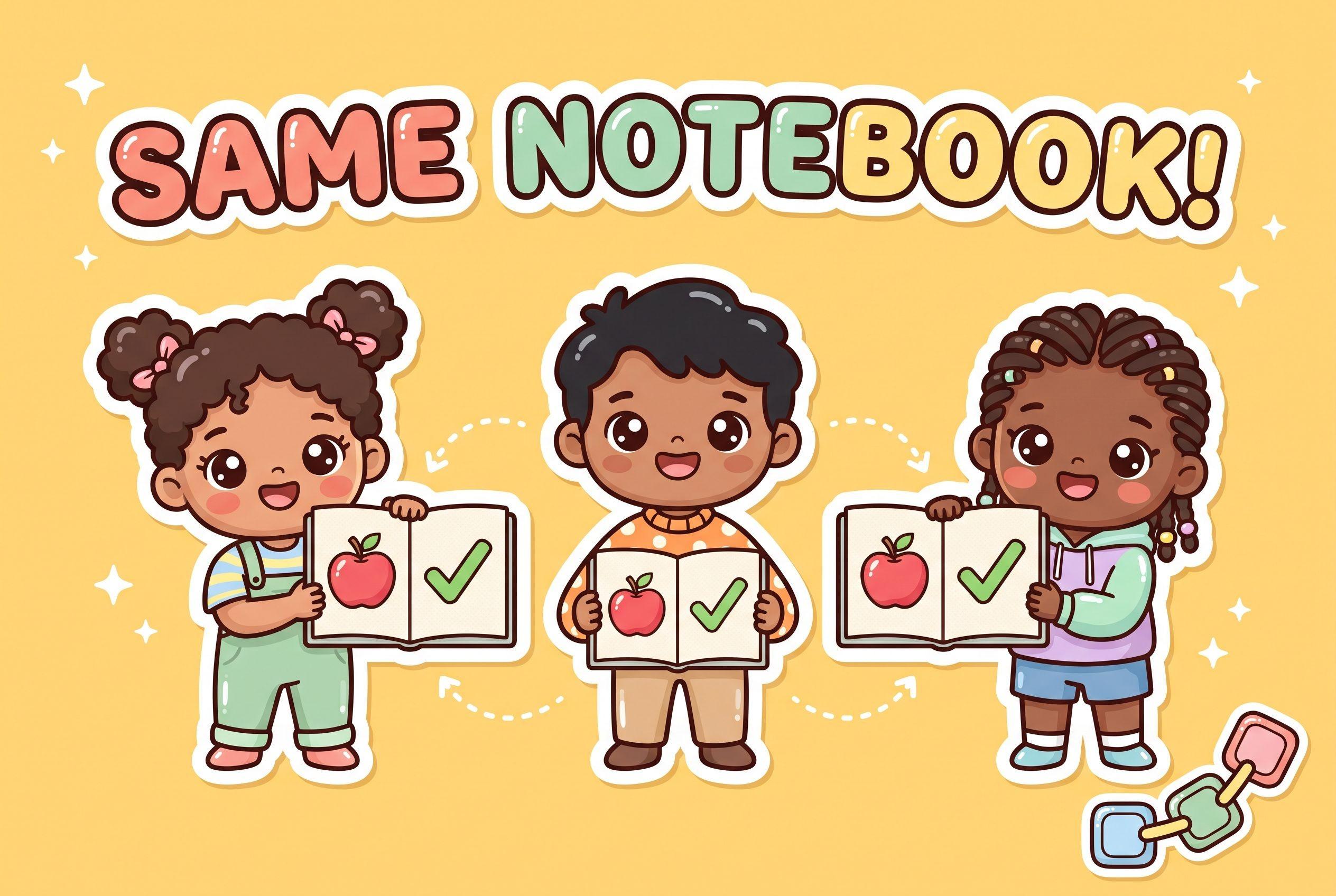
Everybody has the same notebook
You have a notebook. I have a notebook. She has a notebook. They are all the SAME. If I give you my apple, everybody writes it down. Now nobody can say it did not happen.
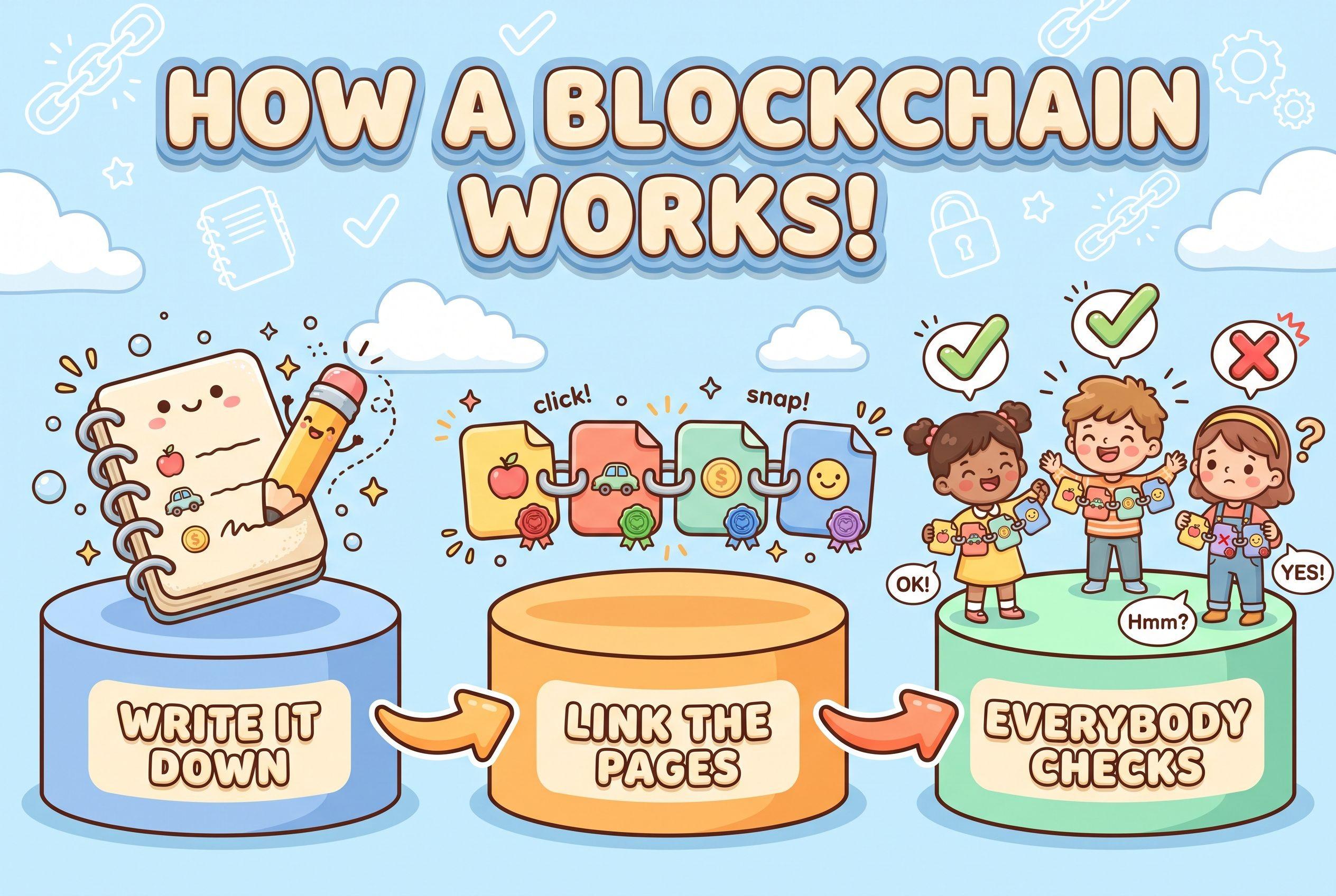
Write it down → Link the pages → Everybody checks
Imagine our class keeps one notebook of who traded what, except every single person has their own copy, and every page is glued to the page before it. If someone sneaks off and changes page 2, their notebook stops matching everybody else’s, and we all see it straight away. You do not have to trust a person. You can check.
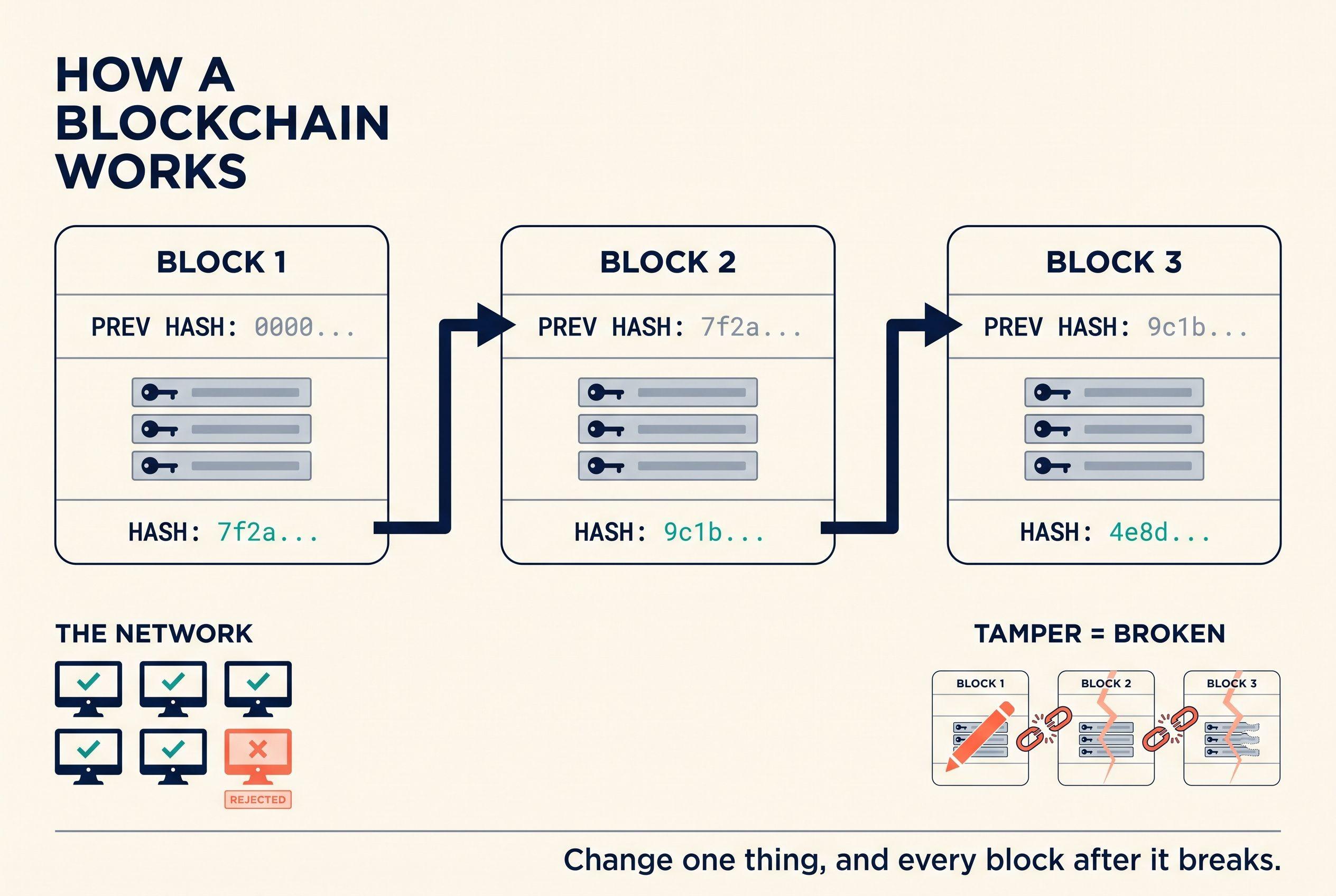
Hashes, blocks, consensus & keys
A hash is a fingerprint for data: feed in a whole book and you get back a short string of characters. Change one comma and the fingerprint changes completely, and you cannot run it backwards. Take a batch of transactions, call it a block, and stamp inside it the fingerprint of the block before it. Do that over and over and you have a chain: changing anything in an old block breaks every block after it. Thousands of computers each hold the whole chain, and consensus rules decide who adds the next block. You prove a transaction is yours with a private key, a secret number that signs it, which anyone can verify without ever seeing the secret.
The five pieces
What the oldest kids should be able to name by the end.
Bonus piece, keys. Your private key is a secret number. Your public key (your address) comes from it and is safe to share. Signing with the private key proves you authorised something without revealing the secret. Lose the private key and the money is gone forever, no helpdesk, no reset. “Not your keys, not your coins.”
The honest part
A blockchain guarantees that the record was not changed. It does not guarantee that what was written is true, or fair, or a good idea. If someone lies to the notebook, you get a permanent, tamper-proof lie, and because it cannot be undone, a mistake or a scam is final. That is exactly why so many people lose money in crypto: the technology is honest, the people are not always.
The most important thing you will say all class.
The one-glance ladder
The story of blockchain
Tell it as a story about a problem: how do you send something valuable to a stranger, over the internet, with nobody in the middle? For thirty years, very clever people chipped away at it, and then somebody nobody can name put the pieces together.
The key idea, literally
Whitfield Diffie and Martin Hellman invent public-key cryptography: a pair of keys where one locks and the other unlocks. Suddenly two strangers can keep a secret without ever meeting. Nothing that follows is possible without this.
Merkle trees
Ralph Merkle works out how to fingerprint a huge pile of data with one small hash, so you can prove one item belongs without sending all the rest. Every blockchain still uses it.
The first blockchain, nobody called it that
Stuart Haber and W. Scott Stornetta publish “How to Time-Stamp a Digital Document”: chain each timestamp to the one before it so the order cannot be faked. Bitcoin’s whitepaper cites them. Their actual problem was ordinary, proving when a scientist wrote something down.
Making spam expensive
Cynthia Dwork and Moni Naor suggest making a computer do a little pointless work before it can send you a message. Cheap for one email, ruinous for a million.
Hashcash
Adam Back builds that idea into something real. This is proof of work.
Two near-misses
Wei Dai describes b-money and Nick Szabo describes bit gold: money with no bank, kept honest by computation. Neither was ever built. Szabo had already coined the phrase “smart contracts” in 1994.
The whitepaper
On 31 October, someone calling themselves Satoshi Nakamoto posts nine pages: “Bitcoin: A Peer-to-Peer Electronic Cash System.” They took Merkle’s trees, Haber and Stornetta’s chain, Back’s proof of work and Diffie and Hellman’s keys, and made the pieces fit. Nobody knows who they are, and they have not been heard from since 2011.
The genesis block
On 3 January the first block is mined. Satoshi wrote a newspaper headline into it: “Chancellor on brink of second bailout for banks.” A timestamp and an argument in the same breath. Nine days later the first transaction goes to Hal Finney, who had downloaded the software because it sounded interesting.
The pizza
On 22 May, Laszlo Hanyecz pays 10,000 bitcoin for two pizzas, the first time it bought anything real. The point of the story is not what those pizzas cost later; it is that somebody had to be first to treat it as real.
A blockchain you can program
A nineteen-year-old, Vitalik Buterin, asks why the notebook can only hold money. Ethereum launches in July: the chain runs little programs, smart contracts, so the shared notebook can hold rules, games, art and whole organisations.
Privacy arrives
Zcash ships zero-knowledge proofs in a real currency: prove a payment is valid without revealing who, whom, or how much. A blockchain that is verifiable and private at the same time.
The loud years
NFTs, DeFi, enormous prices, enormous crashes, and an enormous number of scams. Worth saying out loud to the older kids: a lot of people got hurt, and the hype was neither the technology’s fault nor its friend.
The Merge
On 15 September, Ethereum switches from proof of work to proof of stake and its energy use drops by roughly 99.9% overnight. The biggest criticism of blockchains turned out to be fixable.
Into the plumbing
Regulated bitcoin funds list on ordinary stock exchanges, and banks and governments quietly start using chains for settlement. The revolutionary phase ends the way they usually do, it becomes infrastructure.
Who built it
The people to name
Whitfield Diffie & Martin Hellman
Public-key cryptography, 1976. The keys everything is built on.
Ralph Merkle
Merkle trees, fingerprint a mountain of data with one hash.
Stuart Haber & W. Scott Stornetta
Chained timestamps, 1991. The first blockchain, before the word existed.
Cynthia Dwork & Moni Naor
Proof of work as an idea, 1993.
Adam Back
Hashcash, 1997, proof of work made real.
Wei Dai & Nick Szabo
b-money and bit gold; Szabo also named “smart contracts”.
Satoshi Nakamoto
Bitcoin, 2008. Assembled the pieces. Identity still unknown.
Hal Finney
Ran the software on day one; received the first transaction.
Vitalik Buterin
Ethereum, a blockchain you can program.
Where blockchain is right now
What it is genuinely good at
- Send value to anyone, anywhere, without asking permission, useful when banks are slow, closed, or not an option where you live.
- Keep records nobody can quietly edit, ownership, votes, certificates, supply chains, proof a document existed on a date.
- Run rules that enforce themselves: a smart contract does what it says, the same way, for everybody.
- Let you actually own digital things, art, game items, tickets, names.
- Prove without revealing, zero-knowledge proofs show something is true without handing over the secret.
- Keep working when nobody is in charge. That is the actual invention.
What it cannot do
Say this part clearly.
- It cannot make a lie true. It only guarantees nobody changed the record.
- It cannot be undone. Send it to the wrong address and it is gone. Lose your key and it is gone. There is no support line.
- It is not automatically private. Most chains are public, anyone can read every transaction, forever.
- It is not free of people. Scams and hype are everywhere in crypto, and checking the chain does not tell you who to trust.
- It is slow and expensive next to a normal database. If one trusted organisation can just keep the list, this is the wrong tool.
- Proof of work uses real electricity, far less than it used to, but real.
Looking forward
What might happen next
Frame this the same way as the AI class: nobody knows, and the experts genuinely disagree. That is not a cop-out. It is the most accurate thing you can tell them, and it invites them to have an opinion of their own.
Fairly likely, soon
- • Money moving between countries in seconds instead of days, for a few cents.
- • Digital ID and school certificates you carry and prove yourself.
- • Proving a photo or video is real and was not generated, a direct answer to the problem last class created.
- • Zero-knowledge proofs everywhere: prove you are over 18 without showing your birthday.
Plausible, further out
- • Organisations run by their members and their rules rather than by a boss.
- • Ownership of ordinary things (a house, a share, a ticket) recorded on open chains by default.
- • AI agents that hold their own keys and pay each other for work. The two classes meet: the AI thinks, the blockchain keeps it honest.
The big open argument
Some very smart people think open blockchains will end up under most of the world’s money and record-keeping. Other very smart people think it is a clever answer to a problem almost nobody has, and that a trusted database is simply better nearly every time. Both groups have good reasons, and both have been right about specific things. When adults argue this hard, the question is genuinely open, and the kids in this room get to answer it.
The part that stays human
A blockchain is a machine for not needing to trust anybody. That is a real and beautiful invention, and it is not how you live. You will still choose friends, tell the truth, and keep promises nobody could ever check. Trust between people is the thing worth having; this technology is only for the situations where you cannot have it. And the record of your life, what you thought, what you felt, what you noticed, does not belong on a wall everybody can read. It belongs in your notebook.
Close on this. It is what the whole class is actually about.
The 15-minute STEM block
How the STEM lesson runs inside the sixty-minute class.
min
Explain
The age-3 version to the whole room with real notebooks, then the age-7 three-step version, then the age-12 layer for the older kids. Two or three story beats from the history, the newspaper headline and the pizza always land.
min
Say it back
Pair up. Each child explains “why can’t you cheat in the shared notebook?” to their partner in their own words.
min
Draw or write
The drawing prompt and the journaling prompt, at each level. Both are above.
min
Share
Two or three volunteers show their page. Ask: “What is one thing you would want written down forever?”
Unplugged game, “The Human Blockchain.” Every child has their notebook open. Announce a trade, “Maya gives Tom a sticker”, and everybody writes it down, numbered. Do five or six. Then quietly ask one child to change trade number 2 in their own notebook. Now read trade 2 aloud from three notebooks at once. One does not match. “Who is wrong, the one, or the many?” Then make it harder: ask how to catch a cheat without reading every page aloud. Someone will invent the seal. That is a hash, and they found it themselves.
Knowledge check
Five quick questions, then five to answer in your own words. Anyone can submit and see their results, sign in if you want your answers saved to come back to.
1.What is a blockchain?
2.Why can’t you change something written in an old block?
3.A hash is…
4.Who published the Bitcoin whitepaper in 2008?
5.What does a blockchain NOT promise?
Explain in your own words
Answer these in your own words. Explaining a concept is the best test that you understand it. You can check your results now; sign in when you save to keep them in your account.