
What Is the Internet?
Millions of computers passing notes, explained for every age, with the story of how we got here and an honest look at what it cannot do.
Sponsored by Argo, a private AI journal
What Is the Internet? Millions of Computers Passing Notes
Class 0 asked what a computer is. Class 1 asked what happens when the thinking part learns for itself. Class 2 asked how a lot of people agree on what is true with nobody in charge. This class asks the question sitting underneath all three: how does one computer talk to another one on the other side of the world? The answer is that your message does not travel in one piece, and it does not go in a straight line.
“It gets torn up, the bits race each other across the planet by different roads, and they get taped back together before you ever see them.”
Say this once the drawing and the writing are done, not before. Every age level below is a deeper version of it.
How this class runs, and why the order matters
The concept comes last, not first. The children draw and write before anyone says the word “internet”. Neither prompt is about the topic; each is about a memory the child already has that happens to have the same shape as the concept. Then the concept is taught, and it lands on top of something they have already felt. Do not name the topic until the sharing is done, so that the moment it is named the earlier prompt clicks: “oh, that is what my drawing was.” That click is the lesson.
A time you reached a whole room at once.
Opens onto: One person can reach millions, instantly, from anywhere.
A voice on a phone from thousands of miles away.
Opens onto: Distance stops mattering. That is the whole invention.
The two prompts, before the concept is named
One for the hands, one for the head. Neither one mentions the internet. Read each prompt out whole, then give each child the version that fits them. Every level is doing the same thing, just at a different depth.
Drawing prompt
“Think of a time when a lot of people were all paying attention to you at once, and something you did reached every one of them at the same moment. On a stage. In front of the class. At a family party. Leading a game. Singing, dancing, telling a joke that made the whole room laugh. Draw that moment. Put yourself in it, and draw all the faces looking back at you.”
How did it feel when everybody got it at the same moment? Do not answer it for them, and do not connect it to anything yet.
Journaling prompt
“Write about a time you talked to somebody very far away on the phone. Somebody in another country, maybe another continent. A grandmother, a cousin, a friend who moved away. Put us in the room with you. Where were you sitting? What could you see out of the window? What could you hear behind their voice on the other end, their kitchen, their street, their weather? What could you smell where you were? Did their voice sound exactly like them, or a little different? What did you say to each other, and what did you feel when the call stopped?”
How far away were they, really? Could you point at them? Still do not name the topic.
The notebook is where you keep what a moment actually felt like. A phone call can cross ten thousand kilometres in a fifth of a second, and the only record of what it meant is the one you write.
The STEM lesson
What is the internet, explained by age
Now name it. The same idea, told at the right depth for each child. Explain the youngest version to everyone, then add a layer for the older kids.

You talk here, and it comes out there
Watch. I say hello into this one, and it comes out of THAT one, all the way over there. The computers are holding hands. Your hello runs along and pops out at Grandma’s house.
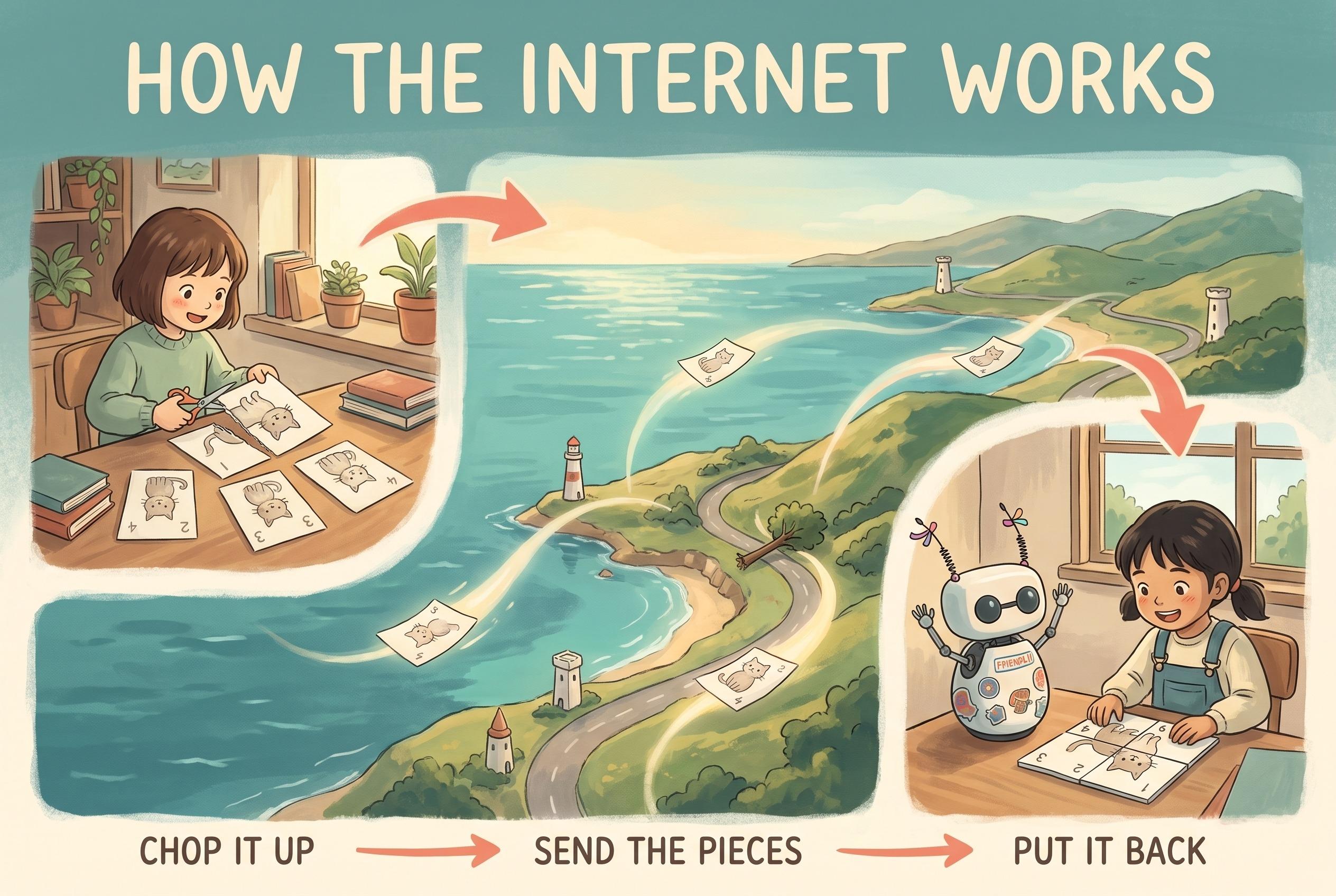
Chop it up → Send the pieces → Put it back
When you send a photo to your cousin, it does not fly there in one piece. Your computer chops it into hundreds of little pieces and numbers them. Every piece is thrown out into the world on its own, and they do not even take the same road: one might go over Europe and one under the sea. Your cousin’s computer catches all of them, sorts them by number, and tapes them back into the photo. All of that happens before you can blink. There is no single road, and nobody is in charge of the traffic, which is exactly why it is so hard to break.
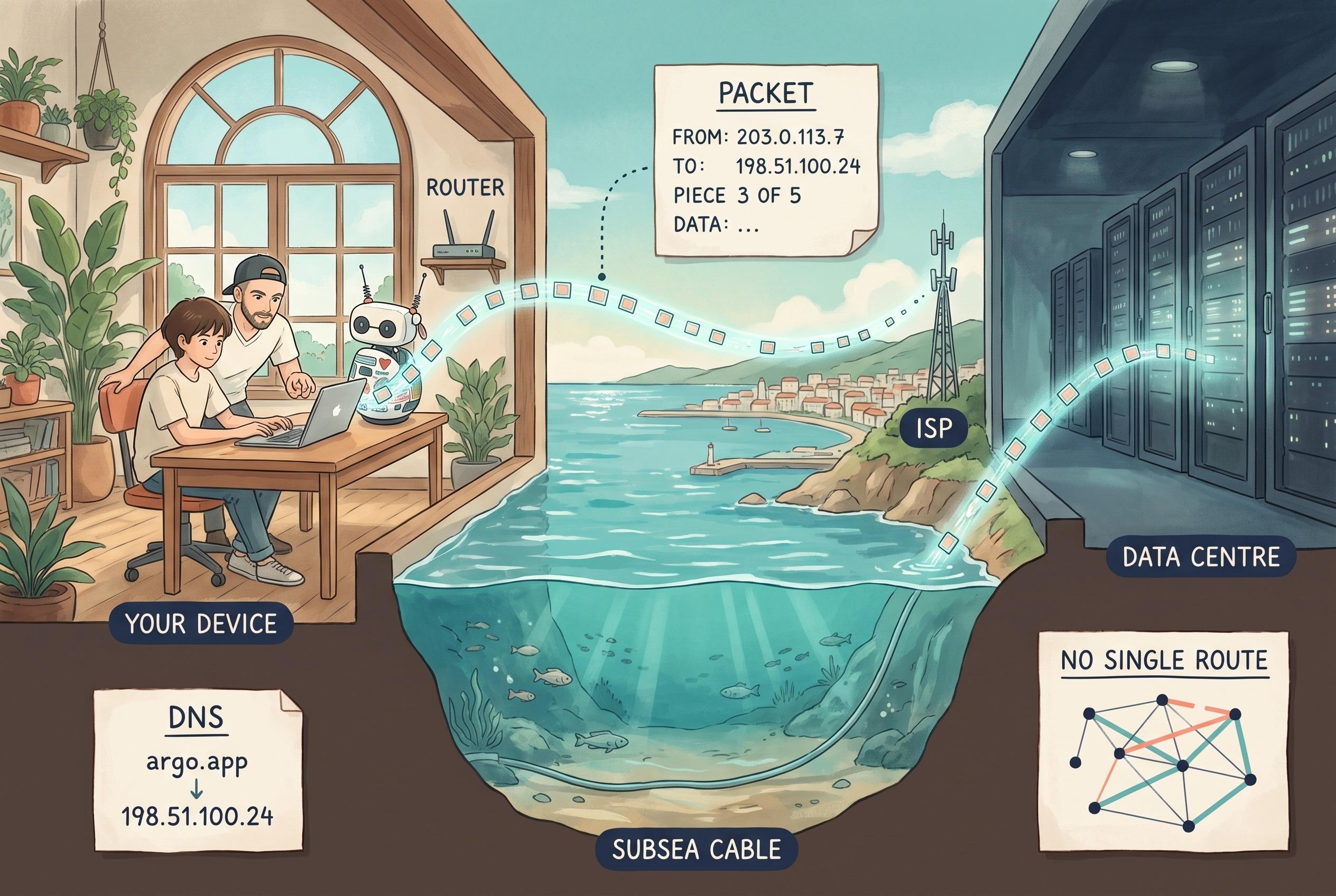
Packets, addresses, routers, DNS & protocols
Every device on the internet has a number, an IP address. When you load a page, your computer breaks the request into packets, small chunks of about 1,500 bytes, and each packet carries the from-address, the to-address, and its position in the sequence. It hands them to a router, which does one job: look at the destination and pass it to whichever neighbour is closer. Twelve or twenty routers later it arrives, and nobody planned that route, each router decided one hop at a time. The reason it all fits together is the protocol, TCP/IP, an agreed format every network on earth speaks, which is why a phone in Malaysia can talk to a server in Chile without either being told about the other. And because humans cannot remember numbers, DNS is the phone book that turns a name into an address.
The five pieces
What the oldest kids should be able to name by the end.
Every router along the way touches your packets, and by default it can read them. HTTPS, the padlock in the address bar, scrambles the contents so the routers can still see where it is going but not what it says. Same idea as the keys from last class: you can prove and protect without trusting the people in the middle.
Two things everybody gets wrong
Say both out loud.
“The internet is the web”
The internet is the network, built from 1969 onwards. The World Wide Web is one thing running on top of it, invented twenty years later. Email, video calls and games are the internet but not the web.
“Things live in “the cloud””
The cloud is somebody else’s computer in a warehouse, reached by a cable. About 99% of the world’s international traffic travels through roughly 1.4 million kilometres of fibre-optic cable lying on the ocean floor. Ships drop anchors on them and countries lose their internet. It is a physical object.
The honest part
The internet was designed to survive damage and to be open. It was not designed to be private, and it was not designed to be safe. Every one of the problems people complain about, spam, scams, surveillance, bullying, misinformation, comes from the same open design that made it work in the first place. You cannot have one without the other, and that trade-off has never been solved by anybody.
The most important thing you will say all class.
The one-glance ladder
The story of the internet
Tell it as a story about a problem: how do you get a message from here to there when the road might be broken, and nobody is in charge of the road? The answer took about a hundred years, and almost every step was somebody refusing to accept “you cannot.”
The first cable across an ocean
Cyrus Field and his backers lay a telegraph cable between Ireland and Newfoundland after four failed attempts. It dies three weeks later, and it takes until 1866 to make one that lasts. The first attempt to wire the world together was a rope on the seabed, and it still is.
Information becomes measurable
Claude Shannon publishes A Mathematical Theory of Communication and invents the bit. Suddenly a picture, a voice and a sentence are the same kind of stuff, and you can work out exactly how much of it a wire can carry.
Three people invent packets, separately
Leonard Kleinrock works out the maths of messages queueing in a network. Paul Baran at RAND designs a network with no centre, one that keeps working after pieces are destroyed. Donald Davies in Britain has the same idea independently and gives it the name we still use: packets.
The first message, and it crashed
On 29 October, a student called Charley Kline at UCLA types “LOGIN” to a machine at the Stanford Research Institute. The system crashed after two letters. The first thing ever sent over the ancestor of the internet was “LO”.
Email, and the @ sign
Ray Tomlinson writes a program to send a note to a person on another computer, and needs a character to separate the person from the machine. He looks down at the keyboard and picks @ because nothing else was using it.
The invention that made it the internet
Vint Cerf and Bob Kahn publish the design for TCP/IP: not a network, but a way for different networks, run by different people with different equipment, to join into one. Everything before it was a network; this made it an inter-net.
The birthday
On 1 January, “flag day”, every machine on the ARPANET has to switch to TCP/IP at once or fall off. Engineers wore badges reading “I survived the TCP/IP transition.” If the internet has a birthday, this is it.
Names instead of numbers
Paul Mockapetris invents DNS, because until then Elizabeth Feinler’s team kept the entire directory of the network as a single file everyone downloaded, and it had stopped scaling. Feinler’s group also came up with .com, .edu and .gov.
Making the wires behave
Radia Perlman invents the spanning tree protocol, which stops packets circling forever in a loop. She is often called “the mother of the internet”, and she dislikes the title, because it was thousands of people, not one.
The Web
Tim Berners-Lee at CERN writes a proposal for linking documents together. His boss’s note on it: “Vague, but exciting.” He builds the first browser and server himself. In April 1993 CERN puts the whole thing into the public domain, free for anyone, forever. He could have been one of the richest people alive, and chose not to be.
Pictures
Marc Andreessen and Eric Bina release Mosaic, the browser that showed images inside the page instead of in a separate window. Ordinary people arrive within two years.
The internet leaves the desk
The iPhone puts it in a pocket. By around 2016, more of the world’s web traffic comes from phones than from computers, and for a large part of humanity a phone was the first internet they ever had.
The stress test
School, work, medicine and family all move onto the internet in about a fortnight. It bent, and it held. Sixty-year-old design, worst-case load, no central controller, and it did not fall over.
Who built it
The people to name
Claude Shannon
Information theory, 1948. Invented the bit and made all of this measurable.
Paul Baran & Donald Davies
Packet switching, independently, in two countries. Davies named the packet.
Leonard Kleinrock
The maths of network queues; his lab sent the first message.
Vint Cerf & Bob Kahn
TCP/IP, 1974. The rulebook that joined all the separate networks into one.
Ray Tomlinson
Network email, 1971, and the @ sign.
Elizabeth Feinler
Ran the internet’s directory by hand; her group devised .com and .edu.
Paul Mockapetris
DNS, so people could use names instead of numbers.
Radia Perlman
Spanning tree protocol, which keeps packets from looping forever.
Jon Postel
Kept the numbers and edited the standards for decades. “Be conservative in what you send, liberal in what you accept.”
Tim Berners-Lee
The World Wide Web, 1989, and then gave it away for free.
Where the internet is right now
What it is genuinely good at
- Get a message anywhere in a fraction of a second, for effectively no money, to anyone who is also connected.
- Survive damage. Cut a cable, lose a data centre, block a route, and the packets go around. That was the original design goal and it works.
- Let anyone publish, with no permission, no printing press and no gatekeeper. A child in Forest City can put something where the whole world can read it.
- Join anything to anything. Phones, satellites, cars, sensors, watches, toys and factories all speak the same protocol.
- Carry everything at once, because it is all just bits: voice, video, money, games, medicine, homework.
- Work with no one in charge. No company, country or person owns it. It runs on agreed standards and a lot of cooperation.
What it cannot do
Say this part clearly.
- It cannot be private by itself. Encryption has to be added on top, and even then, where you went is visible even when what you said is not.
- It cannot forget. There is no real delete. Copies get made instantly, by people and by machines.
- It cannot tell you what is true. It moves bits perfectly and has no opinion about whether they are honest.
- It cannot beat the speed of light. Light in glass crosses the planet in about a fifth of a second, and no engineering will ever fix that.
- It is not everywhere. Roughly a third of humanity is still offline, mostly because of cost, electricity and where they live.
- It is not free of people. Scams, bullying and manipulation live on it because we do, and no protocol fixes that.
Looking forward
What might happen next
Frame it the same way as the last three classes: nobody knows, and the experts genuinely disagree. That is not a cop-out. It is the most accurate thing you can tell them, and it invites them to have an opinion of their own.
Fairly likely, soon
- • Satellites reaching the last third of the world, so where you were born stops deciding whether you get the internet.
- • Talking to computers instead of typing at them, so being online stops requiring literacy in English.
- • Machines outnumbering people online by a wide margin: sensors, cars, farms, household objects, all chattering.
- • More of it encrypted by default, because the default used to be wide open and that turned out badly.
Plausible, further out
- • AI agents doing most of the talking on the network, requesting and paying for things on our behalf. All four classes meet here: the computer runs it, the AI thinks, the internet carries it, the blockchain keeps it honest.
- • A serious attempt at proving a human is a human, and that a video is real, which the internet was never built to do.
- • Computers in orbit, so parts of “the cloud” are literally above the clouds.
- • A splintering: several regional internets with walls between them, instead of one. Some people think this is already happening.
The big open argument
Some very smart people think the open internet is the most important thing our species has built, and that we should defend it exactly as it is. Others think its openness is now its biggest danger, and that it needs identity, rules and borders to stay usable. Both groups have good reasons. The generation in this room will decide it, because the people who built it are running out of time to.
The part that stays human
The internet is a machine for making distance stop mattering. That is genuinely astonishing, and it is not the same thing as being close to someone. Go back to what you wrote at the start of class: the voice on the phone arrived perfectly, and you still felt how far away they were. Being reachable by five billion people is not the same as being known by five. The record of what that call actually felt like is not a broadcast. It goes in your notebook.
Close on this. It is what the whole class is actually about.
After the concept
The teach-back page
“Fill one page that would teach “what is the internet” to somebody exactly your age who has never heard any of this. Drawings, words, arrows, a comic, whatever works for you. The test is simple: it has to work without you there to explain it.”
Teaching it back is the only honest test of whether it landed. It also mirrors what they did at the start: they drew a moment when they reached a whole room, and now they are making something designed to reach somebody who is not in the room. That is the concept, performed rather than recited.
The class, running order
Drawing and writing come first. The concept is not named until both shares are done.
min
Draw
The drawing prompt. Do not say what the class is about.
min
Share the drawings
Everyone shows. Nobody critiques. Ask: how did it feel when everybody got it at the same moment?
min
Write
The journaling prompt. Still do not name the topic.
min
Share the writing
Ask: how far away were they, really? Let the room sit with the distance.
min
Explain
Now name it. The age-3 version to the whole room with the string and cups, then the age-7 three-step version, then the age-12 layer. Two or three story beats, “LO” and the @ sign always land.
min
Teach it back
Fill a page for a peer who was not here.
min
Share the teach-back pages
Two or three volunteers show their page, and we record it.
Unplugged game, “The Human Internet.” Write a short sentence on a strip of paper, cut it into five pieces, and number each piece 1 to 5. Hand the pieces to five children at one end of the room. Their job is to get their piece to one child at the far end, but no two pieces may travel by the same route: they have to hand off through different friends. The receiver lays them out by number and reads the sentence aloud, which will be scrambled and funny if anyone got the order wrong. Then run it again with two children sitting down, “those cables are cut”, and watch the pieces route around them without anyone giving an instruction. Finally, hide one piece before it sets off. The receiver has to notice a number is missing and shout for it again. That is TCP, and they invented it themselves.
Knowledge check
Five quick questions, then five to answer in your own words. Anyone can submit and see their results, sign in if you want your answers saved to come back to.
1.What is the internet?
2.What is a packet?
3.What happens if one route across the internet is broken?
4.What does DNS do?
5.What is the difference between the internet and the web?
Explain in your own words
Answer these in your own words. Explaining a concept is the best test that you understand it. You can check your results now; sign in when you save to keep them in your account.