
What Is Encryption?
How a message can be carried by thousands of strangers, read by any of them, and still be a secret. Explained for every age, with the story of how we got here and an honest look at what it cannot do.
Sponsored by Argo, a private AI journal
What Is Encryption? Hiding the Key, Not the Message
Class 3 ended on an uncomfortable fact: your message hops through twenty machines you have never met, and every one of them can look at it. This class answers the question that leaves behind. Children draw and write about their own secrets first, and only then find out that the trick grown-ups use is not hiding the message at all. It is hiding the key.
“We stopped hiding things. We scramble the message with a secret, hand it over in plain sight, and let anybody who wants to stare at it. It is gibberish to all of them. It turns back into words in one pair of hands.”
Say this once the drawing and the writing are done, not before. Every age level below is a deeper version of it.
How this class runs, and why the order matters
The concept comes last, not first. The children draw and write before anyone says the word “encryption”. Neither prompt is about the topic; each is about a memory the child already has that happens to have the same shape as the concept. Then the concept is taught, and it lands on top of something they have already felt. Do not name the topic until the sharing is done, so that the moment it is named the earlier prompt clicks: “oh, that is what my drawing was.” That click is the lesson.
A thing only you and one other person understood.
Opens onto: Everyone else can see it and still not read it.
Telling one person something, and asking them not to tell.
Opens onto: The whole value sits in who holds the key.
Before you draw
One drawing tip
“Draw the big shape first. Details last.”
Most people start with an eye, or a doorknob, and then find there is no room for the rest. Block in the whole thing lightly, then sharpen.
A tip about drawing, not about the concept. It is the only thing said before the pencils move.
The prompts, before the concept is named
One set for the hands, one for the head. Not one of them mentions encryption. From this class on, each age gets its own prompt rather than one prompt stretched across a ten-year span. Give each child the one written for them.
Drawing prompts
“Draw the place where you keep something that is only yours. A box, a pocket, a shelf, under your pillow. Draw the thing inside it too.”
“Draw a time you and one other person knew something funny that nobody else in the room knew. A look you gave each other. A word you made up. Draw the room, the two of you, and everybody else not getting it.”
“Draw a moment when you were in a room full of people and kept something to yourself. Draw it from where you were standing, so we see what you saw. Then, in the same picture, show the thing you were holding on the inside.”
Sharing question: Who else knew? How did you decide they were the one to tell? Do not answer it for them, and do not connect it to anything yet.
Journaling prompts
“What is something that is only yours? Who is allowed to know about it?”
Spoken. A grown-up writes the answer in the notebook, the child draws beside it.
“I told ______ something and asked them not to tell. Before I said it, my stomach felt ______. After I said it, I felt ______.”
Three sentences. Give them the stems.
“Write about the moment you found out somebody had read or heard something of yours that was not meant for them. Put us there. What can you hear in the room? What goes hot or cold in your body? What do you say out loud, and what do you not say? Finish with one honest answer: did the words themselves change, or did only who was holding them change? If that has never happened to you, write about a time you almost told a secret and stopped yourself.”
Five or six sentences, present tense.
Sharing question: How do you decide who to tell something? Still do not name the topic.
This is the Argo thread: a machine can keep words unreadable, and it has no opinion about who deserves them. The notebook is where that judgement lives.
The STEM lesson
What is encryption, explained by age
Now name it. The same idea, told at the right depth for each child. Explain the youngest version to everyone, then add a layer for the older kids.
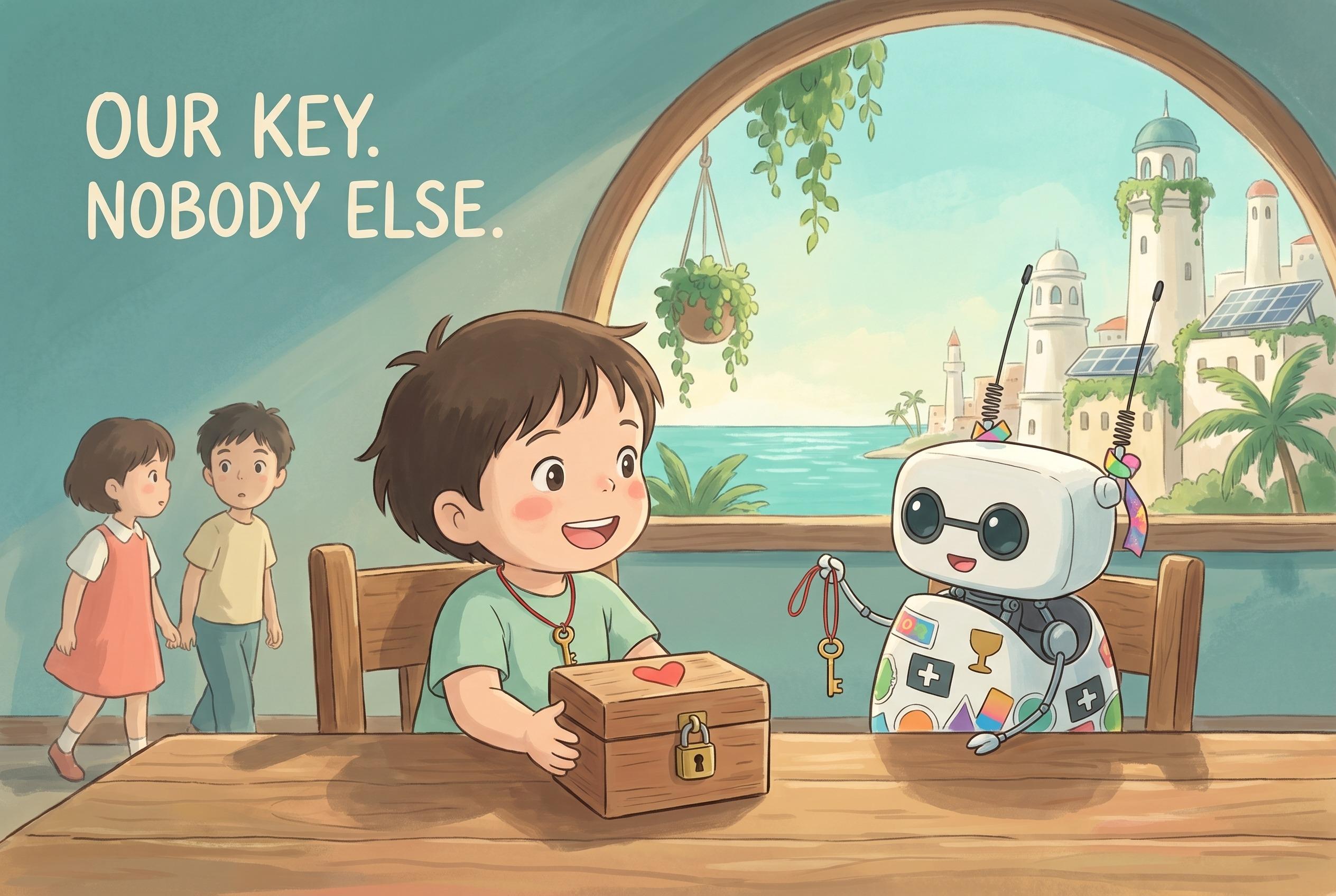
A secret word that only we know
I am going to teach you a secret word. When I say “wobbly”, I mean biscuit. Ready? Who wants a wobbly? Now watch. I will ask the grown-up at the back. Did they know? No. They heard me perfectly, and they still did not know. Keep it physical and now: a word, a box, a key. The one concept is that everybody can hear it, and only we understand it.
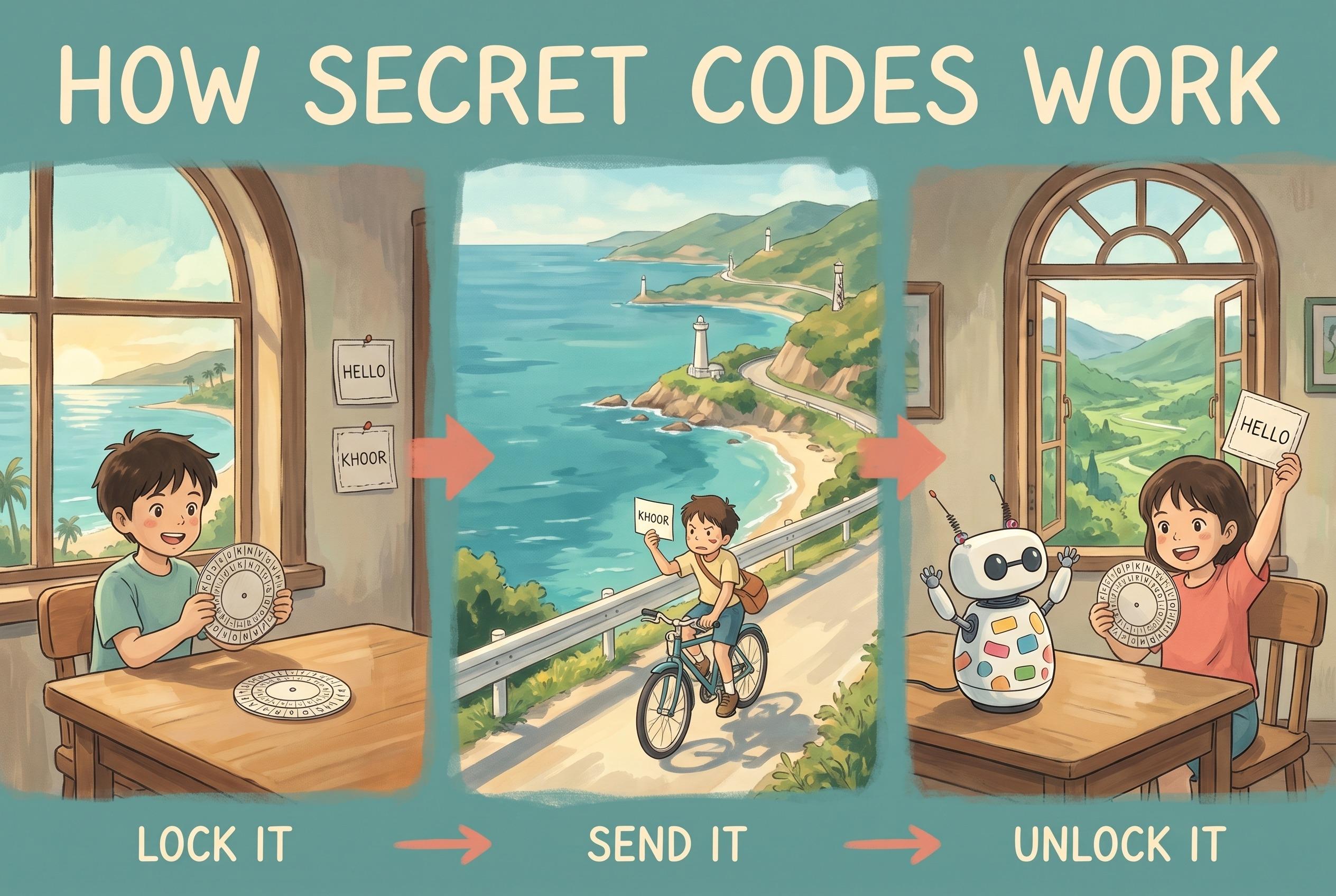
Lock it → Send it → Unlock it
You and your friend agree on a rule: every letter moves three places along the alphabet. A becomes D. HELLO becomes KHOOR. Now write your note and hand it to anybody you like. The messenger can read it out loud on the bus. It says KHOOR. Your friend has the same rule, moves every letter three places back, and gets HELLO. The messenger never had to be trustworthy at all. LOCK IT: change every letter using the rule you agreed, and that rule is called the key. SEND IT: hand it to anyone, they can hold it, copy it, keep it for a hundred years, and it still says nothing. UNLOCK IT: your friend runs the rule backwards and the words come back. You do not have to hide the message. You only have to hide the key.
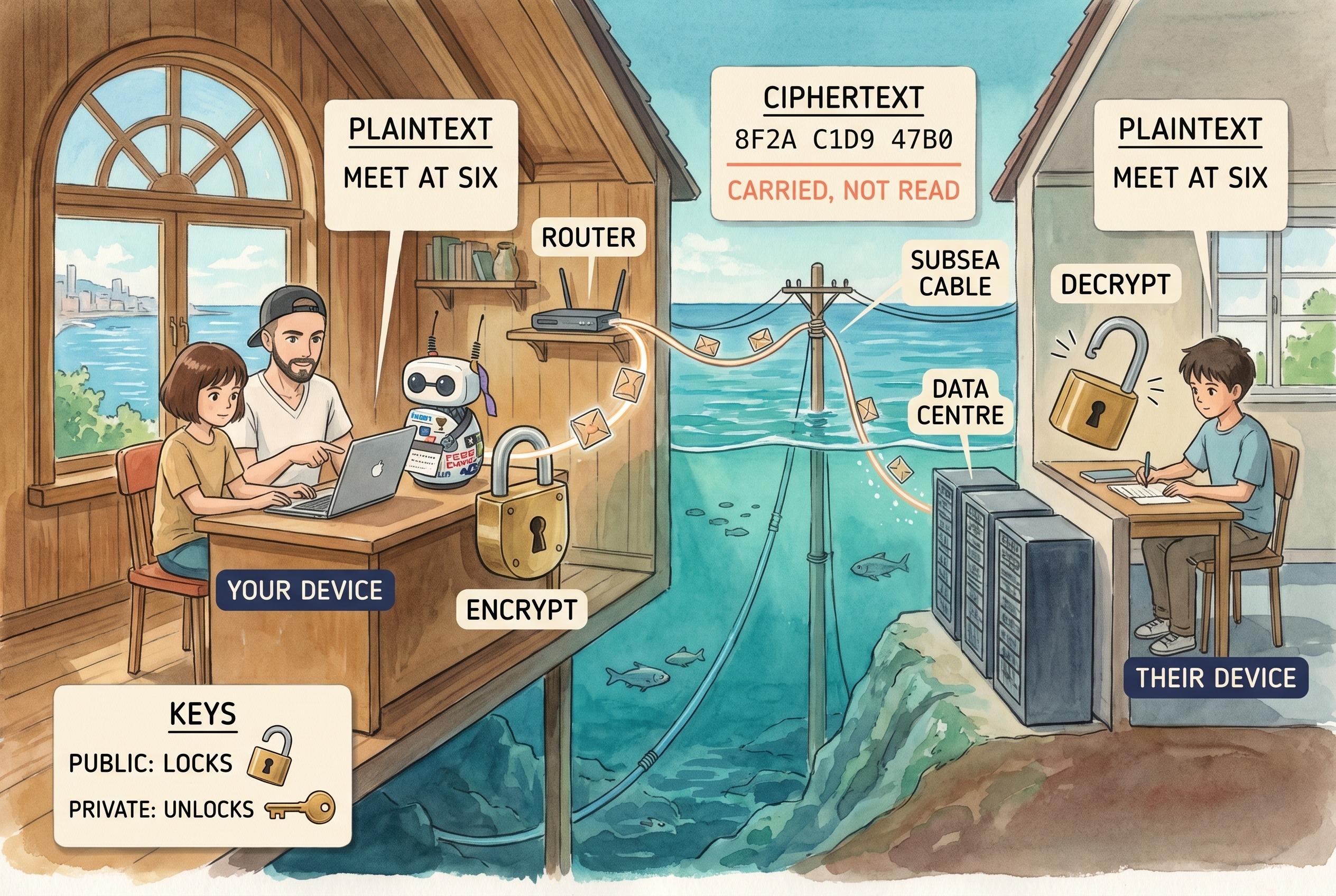
Plaintext, ciphertext, keys, and the padlock you can hand to a stranger
The message before you scramble it is plaintext. Afterwards it is ciphertext. The thing that turns one into the other is the key. Here is the surprising rule: the method is public. Everyone on earth knows exactly how AES works, and that is deliberate, because a method thousands of people have attacked and failed to break is the only kind you should trust. Only the key is secret. Then there is a problem. To share a key with somebody, you have to send them the key, and the messenger is listening. That was unsolved for two thousand years. In 1976 two people solved it: use two matched keys instead of one. The public key locks and you can put it on a poster. The private key unlocks and never leaves your machine. That is why you can talk secretly to a shop you have never met, five seconds after finding it.
The five pieces
What the oldest kids should be able to name by the end.
Bonus piece, hashing is not encryption. A hash is one way, has no key, and cannot be turned back. That is the point: a website can store the hash of your password, check it matches, and never hold the password itself. Same tool as the block fingerprints in class 2. Encryption is for things you need back. Hashing is for things you only need to check.
Two things everybody gets wrong
Say both out loud.
“The padlock in the address bar means the site is honest”
It means nobody in the middle can read what you send. A scam site can have a padlock too. Encryption protects the pipe, not the person at the other end.
“Encryption hides that you said it”
It hides what you said, not that you said it. Who you talked to, when, how often and for how long are all still visible. That is metadata, and it tells a story on its own. The postman cannot read the letter, and he still knows you write to that address every single day.
The honest part
The maths is not the weak point. You are. Properly used encryption has never been broken by guessing keys, and it never will be, because there are more possible keys than atoms in a very large number of galaxies. So it gets got around instead: a password somebody guessed, a phone left unlocked, a person tricked into handing it over, a screenshot taken at the other end. And there is a second honest part. The same encryption that protects your messages protects everybody’s messages, including people you would not want protected. Nobody has ever found a way to build a lock that opens only for the good people. That is not because nobody has tried.
The most important thing you will say all class.
The one-glance ladder
Make it real
Click the padlock in a browser and look at the certificate. Open a messaging app’s security settings and find the safety number, the fingerprint that proves nobody swapped the keys. Then encrypt one sentence with a Caesar wheel and hand it to another table.
The story of encryption
Tell it as a story about a problem: how do you say something to one person when the message has to pass through everybody else? Four thousand years, and every step is somebody being told it is impossible.
The first writing made hard to read
A scribe decorating the tomb of Khnumhotep II at Beni Hasan carves unusual hieroglyphs in place of the ordinary ones. It is often called the first code. Be honest with the room: most Egyptologists think it was meant to look impressive rather than to hide anything.
The first key you could hold
The Spartan scytale: a strip of leather wound round a rod. You write along the rod, unwind the strip, and the letters are nonsense. Only a rod of exactly the same thickness lines them back up. Historians still argue about whether it was really used for secrecy, but it is a lovely idea: the key is a physical object.
Caesar shifts the alphabet
Julius Caesar replaces every letter with the one three places further along the alphabet. Suetonius records it. It worked, partly because most of his enemies could not read anything at all.
Codebreaking is invented, in Baghdad
Al-Kindi writes A Manuscript on Deciphering Cryptographic Messages and describes frequency analysis: count how often each symbol appears and compare it with ordinary writing. E is common, Z is not, and the cipher gives itself away. Every simple letter-swap in the world falls to this, a thousand years before computers.
The alphabet stops standing still
Leon Battista Alberti builds a cipher disk, two rings that turn against each other, so the alphabet can change part way through a message. Frequency counting stops being easy.
The cipher that held for three hundred years
Giovan Battista Bellaso publishes a cipher that uses a keyword to shift each letter by a different amount. It ended up named after Blaise de Vigenère, who described a stronger version later. The wrong name stuck. For three centuries people called it le chiffre indéchiffrable, the unbreakable cipher.
It breaks, and the publisher gets the credit
Charles Babbage works out how to break Vigenère and never publishes it. Nine years later a retired Prussian officer, Friedrich Kasiski, works it out independently and does publish, so the method carries his name. Kids should hear this one: the person who tells everybody is the one history remembers.
The only cipher that is provably unbreakable
Gilbert Vernam at AT&T, with Joseph Mauborgne, invents the one-time pad: a key of genuinely random letters, as long as the message, never reused. Claude Shannon proves in 1949 that it is perfectly secret, and the proof still stands. It is also nearly useless, because you have to get that enormous key to the other person somehow.
Enigma
Germany’s Enigma machine had roughly 158 million million million possible settings, changed daily. Three Polish mathematicians, Marian Rejewski, Jerzy Różycki and Henryk Zygalski, broke it first, in 1932, with pure mathematics, and handed everything to Britain and France five weeks before the war began. At Bletchley Park, Alan Turing and Gordon Welchman built the Bombe to keep up. Joan Clarke was a cryptanalyst in Hut 8, given a nominal job title and less pay because she was a woman; about three quarters of Bletchley’s staff were women. Tommy Flowers, a Post Office engineer, built Colossus, the first programmable electronic digital computer, and paid for parts out of his own pocket because his superiors did not believe it would work.
Cryptography becomes a science
Claude Shannon publishes Communication Theory of Secrecy Systems. The same man who invented the bit in class 3 now gives secrecy a mathematics.
The idea that changed everything
Whitfield Diffie and Martin Hellman publish New Directions in Cryptography: two matched keys instead of one, so two strangers can agree on a shared secret while everybody is listening. Ralph Merkle was working on the same problem in parallel. The twist: James Ellis, Clifford Cocks and Malcolm Williamson at GCHQ in Britain had already found it between 1969 and 1974, but it was classified until 1997, so they got no credit for more than twenty years.
RSA makes it work
Ron Rivest, Adi Shamir and Leonard Adleman at MIT turn the idea into a working system, built on one lopsided fact: multiplying two huge prime numbers together is easy, and working backwards from the answer is not.
Encryption for ordinary people
Phil Zimmermann releases PGP free on the internet. The US government classed strong encryption as a weapon for export purposes and investigated him for three years. The case was dropped in 1996. Supporters printed the source code as a book, because a book is protected speech and a program apparently was not. This was the first crypto war, and ordinary people won it.
The Clipper chip
The US government proposes a chip in every phone with a spare key held by the government. Matt Blaze publishes a flaw in the design in 1994. The proposal dies.
AES, chosen in the open
After an open, worldwide, public competition, two Belgian cryptographers, Joan Daemen and Vincent Rijmen, win with a design called Rijndael. It becomes AES and it now encrypts almost everything you touch. The important part is how it was chosen: in the open, by inviting the whole world to break it first.
The default flips
Documents released by Edward Snowden show how much unencrypted traffic was being collected in bulk. Within a few years the industry turns encryption on by default nearly everywhere.
A billion people at once
WhatsApp switches on end to end encryption for over a billion users, using the Signal Protocol written by Moxie Marlinspike and Trevor Perrin. It is the most widely used encryption in history, and almost nobody using it knows it is there.
Preparing for quantum computers
NIST publishes the first finished post-quantum standards: new maths designed to survive a kind of computer that does not properly exist yet. The concern is real and slightly eerie. Encrypted traffic is being stored today so it can be opened later.
Who built it
The people to name
Al-Kindi
Frequency analysis, 9th century Baghdad. Invented codebreaking.
Leon Battista Alberti
The cipher disk, 1467. The alphabet stops standing still.
Giovan Battista Bellaso
Wrote the keyword cipher in 1553 that got named after somebody else.
Charles Babbage & Friedrich Kasiski
Broke the unbreakable cipher. One published, one did not.
Gilbert Vernam & Joseph Mauborgne
The one-time pad, 1917. Provably unbreakable, barely usable.
Rejewski, Różycki & Zygalski
Broke Enigma in 1932, in Poland, and gave it away in 1939.
Alan Turing & Gordon Welchman
The Bombe at Bletchley Park, which kept the break alive.
Joan Clarke
Cryptanalyst in Hut 8, underpaid and undertitled because of her sex.
Tommy Flowers
Built Colossus, the first programmable electronic computer, and got no credit for decades.
Claude Shannon
Proved the one-time pad perfect, 1949, and made cryptography a science.
Diffie, Hellman & Merkle
Public key cryptography, 1976. Strangers can agree a secret in public.
Rivest, Shamir & Adleman
RSA, 1977. The first working public key system.
Phil Zimmermann
PGP, 1991. Put strong encryption in ordinary hands and was investigated for it.
Where encryption is right now
What it is genuinely good at
- Make content unreadable. Nobody has broken AES by trying keys, and nobody expects to. The number of possible keys is beyond anything a machine could search.
- Let strangers agree a secret in public. The problem that stood unsolved from Caesar to 1976 is now solved so completely that your browser does it invisibly, several times a second.
- Prove who sent something. A signature made with a private key can be checked by anyone with the public one. This is exactly the key pair from class 2, used the other way round.
- Protect things by default. Money, medicine, messages and homework, all encrypted now without anybody choosing it.
- Be public and checkable. The algorithms are published so the whole world can attack them. The ones still standing are the ones worth using.
What it cannot do
Say this part clearly.
- It cannot protect you from yourself. A guessed password, an unlocked phone, a screenshot at the other end, or a person who talks you into handing it over. This is how it actually goes wrong, every time.
- It cannot hide who you talked to. Contents are hidden, patterns are not.
- It cannot tell you whether the other person is honest. The padlock says the pipe is safe, not that the person is.
- It cannot help you after you lose the key. No reset, no helpdesk. Class 2 again: not your keys, not your coins.
- It cannot decide who deserves privacy. The maths does not know who you are or what you are doing, and it never will.
Looking forward
What might happen next
Frame it the same way as the last four classes: nobody knows, and the experts genuinely disagree. That is not a cop-out. It is the most accurate thing you can tell them, and it invites them to have an opinion of their own.
Fairly likely, soon
- • Post-quantum algorithms rolling out across browsers, phones and banks, mostly invisibly.
- • More things encrypted by default, including backups and photo libraries.
- • More laws demanding that companies scan messages before they are encrypted, and more fights about them.
Plausible, further out
- • Encryption that lets a computer do useful work on data it cannot read. This exists, it is called homomorphic encryption, and today it is far too slow.
- • Personal keys used for real identity, so you can prove who you are without handing over everything about yourself. All five classes meet here.
- • Proving a photo or a video is real by signing it at the moment it is taken, which matters more after class 1 than it used to.
The big open argument
Should companies be forced to build a way in for police? One side: serious crimes are hidden behind encryption and investigators genuinely cannot see them. The other side: a door built for one government is a door, it will eventually be found by others, and there is no known maths for a lock that only opens for the good people. Both groups have real reasons and neither is being stupid. This argument is live right now, and the people in this room will be the ones who settle it.
The part that stays human
Encryption keeps a message from being read. It has no opinion about who should read it. You decide that, and you have been deciding it since long before this class, every time you chose one person to tell. Go back to what you wrote at the start: when somebody else got hold of your secret, the words had not changed at all. Only who was holding them. No machine will ever make that judgement for you. It goes in your notebook.
Close on this. It is what the whole class is actually about.
After the concept
The teach-back page
“Fill one page that would teach “what is encryption” to somebody exactly your age who has never heard any of this. Drawings, words, arrows, a comic, whatever works. The test is simple: it has to work without you there to explain it.”
It is the only honest test of whether it landed, and it mirrors the beginning. They started by drawing something only two people understood. They are finishing by making something built to be understood by somebody who is not in the room. Same idea, turned inside out.
Away from the screen
The unplugged game
Unplugged game, “The Nosy Messenger.” Two children sit at opposite ends of the room. They may only pass notes through a third child, the Messenger, who reads every note out loud. Round one: impossible, and let them feel it. Round two: give the pair one minute together in a corner first. They will agree a rule, and the notes start working. They have just invented a shared key. Round three is the good one: a new child arrives who has never met either of them and may never speak to them privately, and the Messenger hears absolutely everything, including any rule anybody says out loud. Let them struggle properly. Then put a box, an open padlock and its key on the table and say nothing at all. Sooner or later somebody works out that you send the open padlock across, the stranger locks the box with it, and only you have the key that opens it. That is public key encryption, and they invented it. Round four, quietly swap the padlock for your own before it arrives and read everything that comes back. That is the man in the middle attack, and it is exactly why messaging apps show you a safety number to check.
Knowledge check
Five quick questions, then five to answer in your own words. Anyone can submit and see their results, sign in if you want your answers saved to come back to.
1.What is encryption?
2.What is a key?
3.Somebody steals your encrypted message but not your key. What have they got?
4.Why have two keys, a public one and a private one?
5.Does encryption hide who you talked to?
Explain in your own words
Answer these in your own words. Explaining a concept is the best test that you understand it. You can check your results now; sign in when you save to keep them in your account.